July 2013
Updates from July 2013.
Update July 16th
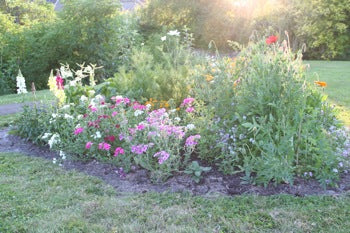
This time a year ago we were fretting over rain, slugs and lack of sunshine. I keep reminding myself about that when worried by the lack of rain, although so far few vegetables are suffering much; it is more that, looking ahead, the weather appears so set in a dry pattern until the second half of August at least. All the sunshine is great for flowers:

Where I had the huge, three day bonfire of conifer leaves.

A new bed of manure made in April, planted through May with annuals mostly.
Planting out in dry soil
One tip for planting out is to make sure the rootballs of module plants are thoroughly soaked before planting. I was putting in purple sprouting and calabrese after potatoes and although I thought to have watered the trays well, their rootballs must have been so dry that even after I dowsed them there was still dry compost. Which is a positive thing about brassicas, how they can tolerate summer heat and dry roots, hibernating in their waxy leaves which go matt and dull looking, but survive until it rains.
Watering
Every so often, after you have watered any soil, leaving it lovely and moist-looking, just check with a trowel to see how far down the moisture has gone - you may be disappointed because in the current waether, plants have been pumping so much water that many soils are becoming much drier than usual, and need a longer watering than usual. If you don't have enough water, or time, you have to make choices about which ones to favour...
Lettuce and most salads need moist soil most of the time, including basil: although they like dry heat for leaf quality, basil plants will produce so much more growth when their roots are kept moist. I am watering all salads every two days and in the current intense heat (28-30C daily) they would not mind some water every day, but it is more efficient to give a slightly longer soak, when soil has enough organic matter to hold onto the moisture, even if the surface looks dry. Watering salads less won’t mean they die, but harvests will reduce and a tendency to flower may increase, so it all depends what you want, how much time you have and how much access to water. I am on a meter and am dreading my bill, can’t find the meter at the moment!

Peas need water when fruiting: on left is Hurst Greenshaft with long pods.

On right is tall Mr Bray with small pods and soft, mealy peas.
Watering Tomatoes
I find these the hardest plant for judging water needs by leaf appearance. For example leaf roll is all too common but mostly appears to be caused by… well I still await a good explanation. I find leaf roll much more on some varieties than others, growing next to each other, so it is not to do with soil, more I suspect from intensive breeding.

It is lovely to have ripe fruit of Matina, Tastery FI, Sungella F1 and Sungold F1.

French marigolds planted between.
Leaf roll which you can see in the images above can make you think the plants are dry when they are not, and this year I have suffered some blossom end rot (blackening of fruit bottoms) which is supposed to be from irregular watering - but what is “irregular”? My only tomatoes affected are in the greenhouse, which I water the same as those in the polytunnel (unaffected by blossom end rot), so I think it is more a question of temperature fluctuations with the greenhouse being hotter by day? Even that does not help much although I have lodged three of the automatic vents wide, wide open to let in more air.

I water these outdoor Sungold every other day (carbon-compost experiment for tomatoes).

My Sweetheart melon plants.
Tomatoes in containers are best watered every day, and in compost-fed soil every two or three days should be enough, although it is tempting to water every day when seeing how dry the surface looks and I have tried this, then noticed the soil was soggy lower down when extracting some bindweed. Use a trowel to check if you are not sure, just a small hole a few inches deep, you may be surprised either way.
RHS Show
We saw Paolo of www.seedsofitaly.com at the sweltering Hampton Court Show and he reminded me how cold and wet it can be in northern Italy, where radicchio and endive seeds come from, his point being that the seeds are perfectly adapted to cold, wet Britain…!
I was giving a couple of talks at the Show and had been looking forward to seeing some nice examples of vegetable growing, but was disappointed. Lots of lovely flowers to be sure and Steph even managed to find some lethal looking, thorny tomatoes, but apart from Sea Spring Seeds, Pennard Plants, Wight garlic and Paolo’s Roman garden, it was mostly olive oil, chutney and other food in the “Growing Tastes” marquee. I find it upsetting that vegetable growing appears to be the poor relation of gardening. Possibly because vegetable gardening is so demanding of time that we are all busy at home when the shows are on, so it is mostly flower gardeners there. Also I think because vegetables are more difficult and time-demanding to grow well, as Cleve West has pointed out. So if you ever feel your efforts are not finding just reward with perfect, abundant, easy growth, don’t worry! you are not alone, and there are ways to grow more effortlessly, with NO DIG top of the agenda to reduce time needed (certainly in proportion to yield), both from my experience and the feedback I receive.

Here I am talking about the importance of regular weeding to diminish perennial weeds like bindweed!

Harvesting
Garlic and onions have loved the fine weather and their leaves look really healthy. Most garlic should be out now and soil replanted with brassicas, beetroot, or salads. It is also a good time for sowing wild rocket, land cress, endives, chervil and (until about 20th) radicchios.

Garlic can be quite green-leaved at harvest time.

White Lisbon spring onion with an unknown garlic variety I grow every year.
Potatoes - a harvest sequence and then replanting straightaway
Potatoes can be harvested anytime you fancy, unless you can water them to keep tubers swelling. Mine are not bulking up much now although the tops are still green and beautifully blight free, oh bliss. The tubers are coming out clean and should store well, especially Charlotte which barely sprouts until March. An advantage of harvesting rather earlier is that soil becomes free for whatever else you want to plant.

With a trowel we planted these Estima potatoes on April 1st through holes in the plastic.

Into firm soil where a manure heap had sat over winter, still with some couch grass

After cutting the tops and pulling back the plastic.

You can see the three inches of manure and potato tubers growing in it.

Each plant gave about 1kg of waxy tubers with less slug damage than usual.

Though I found a fair number of large slugs

Then I walked over the manure/compost to firm and level it.

Before dibbing holes for broccoli and beetroot, with a net against pigeons.
Broad beans and peas are near the end of picking, from April sowings. Aim to clear them as soon as you can after last pick, so their leaves pull no more moisture from the soil.

Tall sugar snap peas are yielding well, going too fast really.

On right I weighed 2.6kg of pods which yielded.... 0.7kg of beans.
Pests
Many insects suffered in the cold spring and are only just regrouping.
Cabbage white butterflies are suddenly rampant and brassicas benefit from covering with mesh or fleece, especially cabbage, cauliflower and calabrese whose edible part can be shredded by caterpillars. On the other hand kale, Brussels sprouts and Purple Sprouting can tolerate some damage and then re-grow in autumn rain, with no caterpillars in the bits we eat, so they can be protected with netting only, against pigeons.
Carrot root fly has been absent here and if you miss the first hatching, there should be no need to cover carrots until the next generation hatch in August. But if you have some mesh handy. it won’t hurt to lay it over.
Aphids have been more numerous than usual, I think here because ladybirds are only just arriving, about two months late! Watering leaves and roots of plants with aphids can keep them in check but there are always a few in hot weather.
Rodents are not easy to catch and I shouod be grateful for any tips, for example I have some kind of voles, I think, in the dug bed of my experiment, chewing the bottoms of carrots from the tunnel they have made, and some beetroot too. Mousetraps have not worked so far, with chocolate.
Pea moth and mildew both appear now and I know no remedy except not to sow late peas! I find they grow so abundantly from spring sowings, why sow again in June and July when we have French and runner beans to eat instead? Similarly, don’t sow any more broad beans whose yield is poor from late sowings.

Photo of July 14th with endive, chicory and last lettuce sowing, for planting by early August, also winter brassicas

Garden view on July 13th

Experimental dug beds.

Undug beds with their same vegetables
July 1st
Summer is showing promise! June has been a mostly good month here for plants, and I loved it after the tribulations of last year’s endless rain and lack of sun, and the cold spring. This table of the last four June’s shows how June 2013 had no great warmth, but was fair in other ways, and the quality of leaf growth reflects this with a glossy sheen and many less slug holes! In good old Britain, dry is better for healthy growth, although by the middle of July we may be hoping for some thundery rain.
Weeds
Another welcome aspect of dry weather is the reduced germination of annual weed seeds, and the ease of hoeing them when they do find enough moisture to start growing. Just be ready for any rains which may cause a lot of lingering seeds to germinate: if you are well on top of annual weeds now, you will cope later and everything is easier. Keep it as a golden rule, deal with seedlings of annual weeds as soon as you see them, far quicker than letting them grow and clearing larger weeds.
Perennial weeds keep coming whatever, from the roots of previous years, as I am finding every day with new shoots of bindweed and couch grass, and I am needing to spend more time than I would like with my trusty copper trowel, removing as much root as possible. I am reassured at least that dandelions and buttercup have almost disappeared, and there were a lot of them!
Mulching with sufficient organic matter to exclude light (up to 6” or 15cm) or covering with polythene have been the most effective so far, and repeated layers of cardboard, in the pathways only, are gradually starving those roots of couch, cow parsley and bindweed. However the snag with strip mulching is that light gets in at the edges and leaves grow towards it, then pop out the side.

This two month old bed needs regular trowelling for bindweed and a nearby carpet-mulch shows how much bindweed is in this part of the garden.

The bed on left had five inches of two year old horse and cow manure, has been scuffled for clover weeds.
Weeds in compost
You can compost roots of bindweed, couch grass, docks and so forth, as long as they are soon buried and have no more light to re-grow. All of mine go in the heap and I rarely if ever see any survive; if they do, you can easily fish them out while spreading compost, to go in the next heap.
Seeding weeds are more tricky as compost rarely achieves the heat to kill them. Unless you are a master composter with consistent heat in the heap, I would send seeding weeds to recycling, where compost does get hot. Incidentally you can make lovely compost without heat, it just takes longer, and is better for valuable fungi which do not like high temperatures.
Summer harvests
June harvests have made a wonderful start to the summer and I hope you are finding the same. Here the greenhouse and polytunnel have been productive with beetroot, peas and broad beans all month, cucumbers and courgettes since 10th and Sungold tomatoes on 25th. The hotbed peas (Kelvedon Wonder), sown in January, have cropped since mid month, and the carrots, beetroot and salads on both hotbeds have almost finished, making them temporarily rather bare. I have been unsure what to plant next as there are quite a few slugs in the manured edges, and not much heat now; nonetheless I shall probably plant a melon and some French beans, just to see, and sow some more carrots as the hotbeds are high enough to be above the flying height of carrot root fly.

Kelvedon Wonder peas from the hotbed, pods allowed to swell gives more to eat and they are still sweet.

Garlic is not ready for main harvest but swelling fast, the photo was June 27th and it has matured since then.

Belstar calabrese, with a later planting on the right of picture.

Mississippi spinach is almost finished, now giving smaller leaves for salad.
June has also offered some good early brassicas: bountiful Belstar calabrese, from a sowing in February; tasty shoots of summer purple sprouting and some Greyhound cabbages with almost no holes. I go through all brassicas to remove their yellowing lower leaves and this keeps slug numbers down, as well as helping me to see weeds which are otherwise hiding.

Swift first earlies give lots of medium size potatoes.

Estima second early potatoes growing on the site of a manure heap in undisturbed soil with couch and bindweed, three inches of manure/compost on top and a cover of polythene, with cardboard because the plastic has holes in.

Lovely waxy potatoes, 1.3kg from this plant on June 29th. There are slugs too, but little damage so far.
Swift new potatoes have finally got up to speed after a hesitant start, and one plant on the bed filled with topsoil yielded 1.4kg. July looks like being abundant for potatoes, with less blight than last year, hooray! Already I harvested a few Estima second earlies, to show my mentoring students how it works to grow potatoes near the surface and under black plastic. It was a weedy patch with lots of couch and bindweed, which are still there but yellow under the plastic mulch, and there were plenty of small, delicious potatoes - Estima is a great salad variety, waxy and high yielding, as it can grow large tubers. At planting time we used a trowel to slightly bury the seed potato into soil which was firm old pasture. Then I spread three inches of cow manure and green waste compost, which tubers have developed in while the roots are exploring the undug soil below. Because it is old pasture there are also many slugs, but thanks to dry weather they are doing little damage at the moment.
Stay ahead, be prepared
The thing to watch now is keeping ahead with having seed and plants ready to fill gaps as they appear, once harvests are finished. This year, after such a cool spring, summer harvests are late and this means less time for the second crops to grow, and a greater need to use plants rather than sow direct, to gain an extra three weeks of growth. You can also interplant: for example I just dibbed holes quite close to maturing shallots, garlic and broad beans, then planted Boltardy beetroot. The young beetroot plants just need to establish and keep ticking over, with an occasional watering and slug patrol, and are then well placed to grow rapidly from August once the other vegetables are gone.

Beetroot planted between broad bean and shallot.

Swede planted between shallot and lettuce.

More beetroot sown in modules, but the golden beet in front is poor seed.

The undug bed is on left, dug bed on right, harvests so far are similar except for more spinach from the undug.
You can also interplant Florence fennel, kale, purple sprouting broccoli and many salads in a similar way if space is short and always as long as you are on top of weeds., which I am sure you are! I know I do go on about keeping ground clear of weeds, and it is for many good reasons such as this, being able to crop more intensively and productively, for little extra effort. So the initial work of clearing soil and making it really clean is repaid in many ways.

Examining the hotbed on a recent mentoring-course day.

One of the salads for a course lunch, looks too nice to eat.

The conservatory cucumbers are growing really well, despite a certain lack of light!
Visit to Garden Organic
Thanks to a discussion event organised by Jane Cobbald of Implementations tools, we (myself, Steph and Josh a professional gardener) were at Ryton Gardens on June 29th, and took the chance to see what is growing.
In the vegetable plots we were surprised and dismayed to find so many weeds, with many plantings showing a lack of exuberance and little evidence of purposeful picking. Much of it looked rather unloved and unkept such that we, who had been looking forward to seeing something good at the national centre of organic gardening, were really disappointed. There were remarkably few plantings of vegetables to give lots of meals and a surprising number of half empty beds. In the cook’s garden I was scratching my head as to what kind of meal the cook could create and the lettuce were unpicked anyway.
I was left wondering what the centre are trying to prove or demonstrate or find out in their gardens. Painful to me was that there was almost nothing about soil, and no experiments I could see.
Fortunately the actual event was good with discussions about the future of organic gardening which converged on a few key points: involving youngsters, using the internet to reach a wider audience, spreading the word about soil as a living entity and helping beginners to start productively. For me this means making some short videos which I shall post links to shortly.

Behind the pink phlox are lettuce planted April 1st.

Longest surviving varieties are Appleby, Grenoble Red, Nymans, Freckles and Lettony: all are showing signs of flowering now after 11 weeks of harvests

A view down the middle with the dig, no dig experiment first, and cardboard against couch grass.

From the other end, these two beds had a three inch layer of topsoil on the grass, then four inches of manure and green waste compost.

I love the healthy growth in early summer and tall peas look especially promising.

Supper on the right shows the wonderful range of harvests at this time of year.