March 2014
A look at Homeacres in March 2014.
Winter rainfall 2013/14 December 128.8mm, January 195.8mm, February 147.9
The 3 month total of 473mm compares with my previous highest total here of 323mm - this winter is off the scale.
The absence of serious cold weather has been remarkable this winter, with only 23 frosts so far, compared with 27 in 2011/12 and 46 in the same period last year. The one month of March 2013 had 20 frosts, almost as many as the whole of this winter so far.
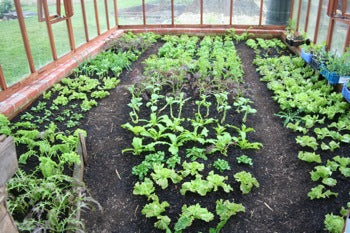
As a result I have seen almost no ice at all in the polytunnel and greenhouse, where growth of salad plants in late February looks more like April.
Outdoors the story has been wind and rain and after the wettest winter on record, I hope your garden is in fair shape for spring - which is already beginning, just gradually, especially in southern areas. After an unsettled first few days, I think March will bring some fine and mild weather, settled, especially as the change is happening on today's new moon.

Greenhouse salads after picking

Tunnel salads before picking on February 27th

Land cress and Maravilla di Verano lettuce which has a pleasing crunch to its leaves.

Garlic emerging through pak choi which is finishing, also chervil and parsley.
Update 7th March
The fine weather has indeed arrived and is here for up to ten days so make the most of it. This is key time for finishing compost spreading and mulching, and for weed control of new germinations of annual weeds, as seedlings almost before you see them. Be proactive, go look for them, don't wait until your surface is green. Currently they are all raring to go after winter and you can kill hundreds, thousands very quickly with a light rake of the surface, or a shallow hoe, or a scuffel with a trowel or hand weeder.
In that way you keep ahead of weeds and have clear space for gardening

The dig/no dig experiment (dug bed on left) with garlic and beans growing

The old chicken run has come through winter in good shape...

In the outdoor beds, Treviso chicory has given a few salad leaves through February

Hungry Gap kale, planted after garlic last July, is now coming into its own with tender and tasty leaves.

Bandit leeks are now starting to swell up outside.

Doric F1 Brussels sprouts have been cropping well since October. I am lucky to have suffered no pigeon damage this winter, I think they are in the neighbour's field of kale.
Weeding
There is still time for lots of preparation if you are behind: filling new beds, spreading some compost on existing ones, tidying plot edges to reduce habitat for slugs, mulching pathways. Above all, being clear of weeds, either hand-weeding or composting, so that ground is ready for plants and with less slugs lurking. If you are starting with a mass of perennial weeds, see the archived entries from this time last year, when I was clearing a lot of weedy pasture with light-excluding mulches.
When the surface of beds dries out, probably from the first weekend onwards, you can either scuffle the surface with hoe or rake, in a gentle, horizontal movement, to disturb weed seedlings. Often before they are visible, so you are exposing lots of tiny weed roots to light and wind, then hundreds are perishing for much less work than if they were left to grow to seedling size.
My golden rules for being free of annual weeds:
- Light hoeings with hoe, rake or trowel, little and often
- Dealing with them tiny, sometimes before leaves are even visible
- Seize the chance in any windows of dry weather, just five or ten minutes can save hours later
Raking the surface
Light raking of surface compost, say a couple of times in March, has two beneficial effects. It reduce the population of weed seeds, and knocks larger lumps into a finer surface for sowing and planting. There is no need for a super-fine surface, just with lumps less than golf-ball size.
My three-bed experiment with dug, undug and composted beds.

The undug, uncomposted bed in the middle after I pullled some surviving mustard plants, that area is for winter squash. I have done some weeding, it took fifteen minutes for the whole bed.

The left-hend side of each of these three beds has rockdust to see what difference it may make.

Rockdust experiment in the greenhouse with Grenoble Red lettuce, before and after a picking.

So far the tray with rockdust on top (on left) has yielded 212g compared with 175g from the tray with only compost.
Sowing outdoors
In milder areas, you can sow radish and broad bean outside now. From mid month if it is not cold, outdoor sowings are possible of peas, lettuce, spinach, carrots and alliums except for leeks (they are better sown in mid April). When sowing direct, soil must be completely clean of weeds and with no overgrown areas nearby, where slugs are likely to be lurking, which can result in much damage to tiny seedlings.
Slugs and plant raising
If you suspect that slugs are numerous, anywhere near to new sowings, I suggest raising plants instead of sowing direct, because a well-grown plant can resist more slug nibbling than a tiny seedling. Homegrown plants also tend to be stronger than bought ones which often look glossy and lush, from being raised in an ideal environment. Then when planted out, they do not have the resources to cope with outdoor life, unlike your own plants which may be smaller, but are more resilient.
Undercover
Main sowing action is still undercover, with this first week being the ideal time to sow tomatoes, in as warm a place as you can manage, even out of light until you see first leaves. Same approach for peppers, chillies, aubergines, but wait until late March for melons and basil, and April for cucumbers.

Greyhound cabbage sown 14 January

All other seedlings sown 29th in trays on the hotbed, now suddenly are growing with no extra heat

So I use the greenhouse hotbed mainly for germinating seeds and a lot of the trays there are spinach and onions.

Shallots germinated and growing well - moss is from the hotbed's high humidity, not harmful - but the right hand, empty side of the tray was sown with Stormy Hall Sturon onion seed which, again, has not germinated.
The empty side of the tray above was sown with Stormy Hall Sturon onion seed which, again, has not germinated - yet when I asked, they assured me that a test in December 2013 gave "a germination rate well above EU standards" (mail from Stormy Hall 26 Feb). How can this make sense? In this tray, the Sturon has grown one plant out of about 50 seeds, with conditions good for germination and growth as the shallots have come up well.
There is still time to sow onions but don’t delay: multi-sow modules/plugs with five to eight seeds. I find that in fertile soil, five onions in each clump, planted 30cm (12in) apart, gives bulbs of a good size. Last year I planted seven multi-sown modules in rows across a 1.5m (5ft) bed and harvested 5.5kg per row (31 onions), slightly less of red onions. Red Baron grows well from seed and is less prone to bolting (flowering) than when grown from sets.
Spinach is also good for sowing asap, because it will always flower by late June, whenever it is sown in spring. Therefore earlier sowings make more harvests before flowering time. The opposite is true for chard and leaf beet (sometimes called spinach), which are biennial and flower after winter, so if they are sown too early there is a risk of induced flowering from exposure to cold. Sow leaf beet in April and chard in May for longer-lived plants, often cropping for a whole year.
Celeriac and celery can be sown from mid March, preferably with some warmth so a windowsill is good; I keep the seed trays over my hotbed. Seed germinate best in light so scatter on top of moist compost, with none on top of the seeds, then cover the tray with a sheet of glass, for two or three weeks until leaves are growing.
I sow peas in modules, early to mid March, two or three seeds in each, for planting late March to early April.
Beetroot grow well in clumps of four to five, sown now, four seeds per module.
Planting out (plants not seed)
Towards month’s end and especially after the equinox, outdoor plantings become viable - the first modules of lettuce, spinach, beetroot, onion, shallot, pea, cabbage, calabrese, coriander, dill - as soon as you have viable plants whose roots have filled their module compost.
For me, a golden rule of early planting is to cover newly planted beds with fleece, either laid directly over plants or slightly raised if stems are tender, such as peas. The closer that fleece is to soil level, the more warmth it can hold around plants. Also it is more stable in wind and less likely to tear. I have never used fleece on bare beds before planting, you can if you want but I am not convinced it makes a worthwhile difference. Last year we planted into very cold soil and plants grew well under fleece laid after planting.

I emptied last year's hotbed, putting its compost and manure on beds in the garden, then...

Had wonderful help to refill it from students on my market gardening weekend course, February 22nd. Here they are unloading fresh horse manure from Jenny's heap.

The next morning was damp, we continued and filled the growing bed with old manure and my own compost, then the following day I planted it with month-old seedlings of shallot, long red onion, spinach, beetroot, radish, some older dill, coriander and sorrel and I sowed some carrots too.

The temperature rose to 45C within eighteen hours, towards the middle of the underlying manure.

Then I covered the bed with fleece over a low cloche, you can see the first hotbed behind.

It gets a little steamy under the fleece which is perhaps helthier than having a polythen cloche, though less warm.
Planting sets and tubers
It is that time again, first early potatoes can go in the ground now, but wait until equinox or later for planting other potatoes and onion sets, to reduce the risk of bolting. Early potatoes could well be showing leaves by mid-April this year, and then one needs to earth them up, perhaps to cover them at night as protection from late frosts, - or you can leave them and hope for the best. Sometimes I have found that early plantings, with some damage to leaf and stem in late frost, but with well established roots, crop as well as undamaged later plantings of potatoes.

First early potatoes Swift have been chitting and can now be planted.

The overwintered Habanero chilli plants now need picking and pruning.

Final thought - a gift from tree surgeons, but the woodchips are enormous in size and I am unsure how to use them, may leave them piled like this to rot down.
Update on 13th March
We are in the swing of spring, the weather alternating between warm sun and cold wind, often rather quickly. Importantly, the ground is drying out at last and the speed of transition from sticky, wet surface to a looser, dry one has been rapid. After a long, wet winter there is plenty to do.

Sunrise over Homeacres garden, fleeced beds showing white.

All the salad leaves are outdoor-grown (lambs lettuce, land cress, beetroot leaves, mustards, spinach) and they are on a bed with broad bean plants from a December sowing.

The old and the new: Boltardy beetroot harvested March 11th

Shoots of Daubenton kale popped into dibbed holes in a bed, to make new plants by May.
[gallery columns="4" ids="985,986,987,988"]
Planting out
The greenhouse hotbed has worked well, providing gentle warmth to seeds and seedlings on top since late January. Its temperature a foot inside has dropped about 10C to 40C (104F), and its success at getting early growth underway, together with mild temperatures generally and reasonable light levels through February, meant I had plants ready to go out in early March. They were sown in mid to late January (see earlier posts) and on March 9th/10th I decided to plant some.

Emerging onions with pricked-out dill, parsley, orache and lettuce, on a pallet on the hotbed where the thermometer was reading 13C in the compost on a morning of 7C in the greenhouse (photo by Heather Edwards).

Plants on right were sown mid and late January, are lettuce - beetroot - cabbage - shallot - onion.

Before dibbing the planting-holes I used my dibber to make shallow drills in the surface so that plants sit deeper and their leaves are then mostly just underneath the fleece, less inclined to suffer damage on frosty nights.

These beds are the main dig/no dig experiment, dug bed on left, both planted the same, with garlic at this end and broad beans at the far end. The grwy on left of each bed is rockdust, an experiment within the experiment.
[gallery columns="4" ids="989,990,991,992"]
Covering with fleece after planting (not necessary before) is the key thing, to protect plants’ tender leaves from cold winds. Fleece does not keep frost out but small plants of lettuce, onion, shallot (both the latter from seed), spinach, peas and Boltardy beetroot can put up with some freezing, then grow by day in the shelter and warmth under fleece, especially when it is laid flat on them. Such that by the end of March, there is small but worthwhile new growth above ground, and excellent growth of new roots which then create strong new leaves through April.
Presently a most helpful thing for new plantings under fleece is dry weather, to reduce slug movements while plants are tender, as they settle in. I water plants in straight after putting them in the dibbed holes, then again after about a week if it has not rained.
Raking, weeding, planting
Beds with compost on top can be raked lightly now, both to even out the surface and disturb any weeds already germinating. Running a rake lightly, horizontally through the top inch or two can save a lot of time weeding later, and makes a smoother surface for planting into. Even after doing this, I am dibbing holes into some quite lumpy compost, especially this year after an absence of frost to break down the lumps. Plants grow fine.
Sowing into surface compost
For direct sowing of carrot and parsnip, I have beds with some finer compost on top, but it does not need to be super-fine. When I was sowing some carrots during a recent course, there were comments on how my seedbed was less fine than expected and I think that one can overdo the fineness of tilth for sowing. Don’t worry if there are lots of small lumps, say pea to marble size, and make your drills quite shallow, never more than an inch except for peas and beans.

This hotbed was made five weeks earlier. BUT was mostly sown rather than planted. It is the last time I make a hotbed in January!

The stormy weather blew a lot of heat away and growth has been less significant than on the second hotbed made 22-23 February (see earlier posts), which I planted on 24th, just 16 days before this photo. The only direct sowing was carrots which are emerging nicely.

There are radish almost ready on the second hotbed, between beetroot plants and coriander in foreground.

Reading of a thermometer I pushed one foot into a pile of woodchips, over 50C!
Sowing undercover
See below for more on this. There is still time to sow tomato, onion and shallot, but don’t delay. It is an excellent time to sow celeriac and celery on a windowsill, on the surface of a small tray with no compost over the seed and a glass tray on top: allow two weeks at least before expecting to see tiny leaves. Peas crop well when sown now in modules, for planting early April; they should start producing peas in June, before pea moth and mildew become a problem.

Leaf radish has loved the mild winter and grown a huge number of leaves, and a small radish root as well.

Endive Fine Maraichere which has been picked several times of its outer leaves, a fiddly job as they are close to the compost and need careful washing, but their stems are blanched and pretty.