May 2021, coping with cold weather and perennial weeds, new seedings new harvests, woodchip

Weather rules.
This is turning into a difficult spring, with temperatures significantly below average – in particular by night. In the UK, there have been more frosts in April than in any other April since records began. Homeacres has had air frosts on 16 out of 27 days so far this month. The average night-time temperature in April has been lower than in January, and the lowest for the UK since 1922.. Plus it was very dry until 28th, when we were fortunate to receive 14mm/0.6in rain.
One positive is that sunshine levels have been high, and anyone with access to a little water has been able to keep new plantings watered. However, bottom line is that without warmth, plants do not grow and if you have not been using covers over new plantings, they will still be small, even struggling to survive. See more on covers in my new video filmed 24th April 2021, also in this video.
Covers I recommend include horticultural fleece of 25 to 30gsm/1 oz per yard approximately, and cotton muslin or toile if you have some of that. A cover directly on or suspended over plants increases growth in three ways:
- by sheltering plants from wind
- by increasing warmth when there is sunshine
- by protection from pests.
A fleece cover does not actually keep out all the frost, as I notice regularly here. For example yesterday morning 27th, I removed a frozen cover of 30gsm “frost fleece” which was on lettuce, and many lettuce leaves were actually frozen. Fortunately this was -1.3C and not like a hard winter frost. By 9:30 am, we were picking leaves from those plants and they were very tasty! If the lettuce had been French beans or courgettes, it would have been end of story.

Lettuce 6th year same bed, transplanted 33 days earlier as five week old plants, varieties are Lollo Rossa, Saragossa, Tesy, Maureen, Navara, Lollo Bionda. Cover was fleece and is now Thermacrop on hoops

View on 17th April on a frosty morning -2C 28F and most beds are covered, with small transplants growing only slowly.

Plants in this bed have grown faster than elsewhere, from proximity to a building which reduces frost at night, they were transplanted five weeks earlier with fleece directly on top, and already I harvested spinach, lettuce and radish
Covers example
On 19th April, four weeks after we had transplanted the lettuce, I switched the cover from fleece directly on top, to Thermacrop suspended on hoops. The photo above left shows the result one week later, and the photos below show the process.
Also you can see how much the lettuce grew in one week after this (in photo above), following an improvement in the weather, with much more sunlight. Nights were still frosty but not quite so cold.

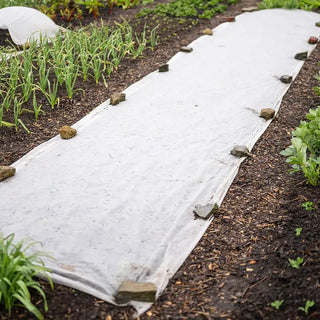
I use stones to hold covers in place, and I’ve rolled back one side and am about to roll up this piece of fleece, which can be reused again several times

This is how the lettuce plants looked on the 19th of April after four weeks under the fleece. We had watered them three times up to this point, through the cover.

The cover is now Thermacrop, and the hoops are 4 mm high tensile, galvanised steel from Reddifast Steel
Growing information
We have separated out the lessons of Course 3, to make them saleable as individual items. The photo gallery below is to give you an idea.
There are 30 lessons, some with more than one video. I have priced them according to how much information is in each lesson, and the length of new videos.

The carrot lesson of Course 3A has 5600 words, 50 photos and a video which shows how to grow carrots from sowing to harvesting. The video also includes a look at a parsnips, and the lesson costs £15

The tomato lesson of course 3B has 9600 words, 111 photographs and a video of growth through late spring and summer, both undercover and outside, the cost is £18

Warmth loving plants – the sweetcorn, melon, and capsicum lesson of Course 3B has 8400 words and 78 photos, with three videos. It includes chillies as well as peppers, and costs £16
Sowings direct
Early direct sowings this year are growing more slowly than usual, because of low temperatures. The covers have really helped, but even so my parsnip seedlings are so small, after five weeks.
For carrots, the intersown radish help by holding the cover above those tiny first leaves of carrots. Carrot seeds are particularly small, and need decent conditions for the first month as they establish. After that they become much stronger.
For the first three weeks or so after sowing, the cover is good when flat on the ground, because it holds warmth at ground level. This is one reason I don’t use hoops too much in early spring, another is that covers risk blowing away.

Radish almost ready 34 days since we sowed them, carrots are slow, under fleece cover and intersown

First radish harvest at 34 days, still small but mild and juicy French Breakfast

Direct sown parsnips emerging, 37 days since sown and with fleece over the whole time, watered twice
Propagation under cover
The CD 60 trays are proving good for most sowings, even broad beans. They are economical with compost. I am discussing compost with Moorland Gold, whose product is more variable since January.
For faster growing plants like cucumber and squash, I sow in the larger 5cm/2in cells of polystyrene trays (not now available to buy), which equate in size to Containerwise 40 L
You can buy my 60 cell trays from various distributors across Europe, including the Farm Dream in The Netherlands.
See my latest sowing tips in this video filmed 24th April. Don’t sow runner or climbing French beans yet, for outdoor planting, my 2021 Calendar is still relevant for all these dates still to come.

Broad beans in the small amount of compost of CD 60 module trays, single sown

Chard seedlings multisown with two or three seeds per cell, on 27th April, nine days since sowing

Hotbed plants include a few already potted on, all except leeks are warmth loving and most are in CD60 trays, except tomatoes and cucurbits

15th April Celery seedlings were pricked out eight days earlier as three week old seedlings, this tray has been on hotbed

The same tray of celery Victoria, 13 days later and now seven weeks since sown
Hungry gap
In terms of harvests, we are heading into the leanest month of the year. The merry month of May can be the hungriest for vegetable harvests, especially if the weather stays cool. And stored vegetables are finishing soon.
I am on my last jar of sauerkraut which still tastes really good, and I’m just eating the last apples, stored in boxes in my garage. While appreciating all the fresh greens, including the first asparagus (slower than usual), I still have some winter roots in the shed: Oxhella carrots, celeriac, beetroot and Charlotte potatoes. Also garlic, onions and Crown Prince squash in the house.

Sauerkraut at 6 months and made from Filderkraut cabbage, is still delicious

I picked these in a frost and they were great to eat, slightly sweeter because of the cold. Spinach, chervil, chives, parsley, lambs lettuce.

From store on 28th April, apples, Prinz celeriac, Charlotte potato and Oxhella carrots
Vegetables harvesting now, end April
From sowings in summer and early autumn, there are quite a few nice harvests you can be taking now, in regions where winter is not too cold. Our lowest temperature this past winter was -7 C/19 F. Spinach can survive much lower than that, just remember to sow it in August.
Find more sowing and harvesting dates, in this online course lesson of Useful Information.

Purple sprouting broccoli, variety Claret F1 sown last June and now 10 months old, has been cropping three weeks already

Medania spinach on a frosty morning, the purchased seed is on the left and home saved seed on right, I must have selected darker leaves

Cabbage for spring is Advantage F1 from Mr Fothergills, transplanted in October and now seven months old, was icy under the mesh which is against pigeons
Onions, salad onions
Onions (and leeks, garlic) are hardy plants, as you can see from the first photo of overwintered salad onions. Also the photos are to show you how it’s fine to lay fleece on top of onion seedlings, whose leaves are surprisingly resilient.
Thanks to no dig, we have done almost no weeding on any of these beds. It makes gardening fun. And I use no fertilisers or slug pellets. Feed your soil life and they grow resilience, health.

Overwintered Lilia spring onions, 8 months old and multisown 30th August, no protection given in winter

Multisown onions pushing up fleece, very slowly, with frosted broad bean plants to right

Although onion leaves look so frail and fragile, when combining together they can push up a fleece, and also keep warm when it is close on top of them. These are Ramrod for salad onions, transplanted five weeks
New plantings are growing, slowly
I was delighted to make the first harvest of new lettuce, even after there had been a frost just two hours earlier. Once plants reach a certain size, they have sufficient roots to ensure that growth continues.
This is especially true now, when light levels are strong and long, equivalent to August in fact. Light can to some extent can balance the low temperatures, especially where covers are used. They convert otherwise-unused light, to necessary warmth.

Frost on Navara lettuce 27th April, then shortly after we picked some outer leaves. It was under fleece and temperature was -1.3C, below freezing four hours

Boltardy beetroot tucked under fleece, we transplanted the multisown modules one month earlier
Perennial weeds emerging in the new area
One of the joys of summer has begun, namely bindweed! This one is the small leaved, pink flowering ‘field bindweed’ Convolvulus arvensis. There is also the climbing hedge bindweed (not in the area but in nearby hedges) with larger, white flowers Calystegia sepium.
I knew from seeing this area last year, that there would be a lot of Convolvulus, and we (mostly Adam, is @ads.wood on Instagram) are now removing the new shoots every week or so. See my captions to the photos, and module 4 of course 1 about mulching weeds, plus my Course 1 book.

The new area on 25th April, where there is now a lot of bindweed emerging and growing!

Cow parsley / common hogweed taproot (Heracleum spondylium) is common in the new area. We remove as much as possible with trowel mostly, then regrowth is weaker, should stop by midsummer

New beds 27th April with emerging couch grass, bindweed and hogweed between spinach, the compost is purchased ‘green waste’ from local facility £50/tonne delivered

Field bindweed & couch grass + hogweed all with roots, from a 7m/22ft of bed, and all this is going on the compost heap

The same perennial weeds with roots on my compost heap, same day, including bindweed
Woodchip uses and value
This is an amazing resource, which you may be fortunate to have available in your locality. Do make some enquiries! Wood avoids the worries about weedkillers in composts – see this Twitter group if you are concerned about that.
For my commercial use I find it worthwhile to buy three ton loads, of new or old chip, for around £72 including VAT. Or sometimes it’s free!

Woodchip piles are two month old poplar woodchip closest, one year old mixed wood further, and green waste compost behind is under polythene to hold moisture

Same piles after tidying by Adam, two month old poplar woodchip closest, one year old mixed wood further, and green waste compost under polythene to hold moisture
As woodchip ages, it turns more and more to compost. We are trialling it’s nutrient content, after sieving year old chips to about 10mm size. In the sowing video I start a potting trial to compare it with potting compost. Its texture is nice and open, but nutrients are probably in small quantity for a while yet, because it still looks woody after sieving.

The black base-layer of green waste compost contrasts with the colour of woodchip compost in 7.5cm/2.5in layer on top at one end

Homemade compost closest and wood chip in further half to same depth, while the bottom layer both ends is green waste

On the same day as making the bed, plantings are spinach, onion, lettuce, carrots, potatoes – same planting and sowing for both halves

Five days later on 27th April and leaves are slightly frozen (not damaged), despite the Thermacrop cover
No dig in Bangalore
I was thrilled to receive photos from Bangalore in India, because I can share with you the success of their beds and the wonderful harvests they are taking already. Sekhar Reddy works as software engineer, has a family and little spare time.
He and his family are delighted with no dig progress, and all the food produced by their beds.

Shade cover helps in the hot climate, pre-monsoon at this point I believe

Bangalore no dig garden by Sekhar Reddy- beds made January, with shade netting over

Fantastic productivity and fresh harvests, no dig in India Bangalore with wife of Sekhar Reddy harvesting